I Turned 60. And I'm More Interested in What's Beginning Than What's Ending.
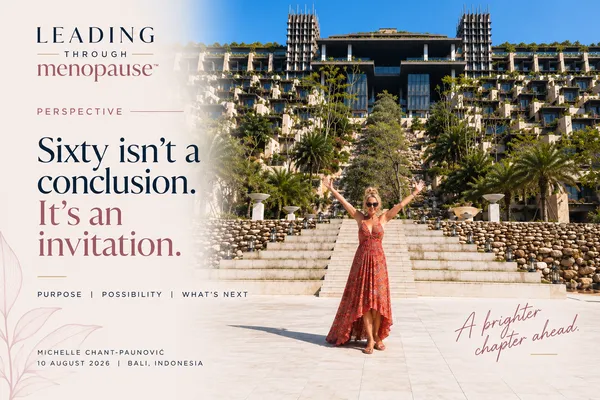
I turned 60 a couple of weeks ago.
I didn't immediately write one of those reflective birthday posts about everything I've learned.
Maybe I needed a little time to work out what this birthday was actually trying to tell me.
If I'm truthful, turning 60 left me a little in awe — and a little shocked.
Sixty.
How did that happen?
I certainly don't feel 60. Well, not all of the time anyway.
But there's another reason this particular birthday feels significant.
My mum died from cancer when she was 59. I was 28.
So there is something slightly surreal about reaching an age my mother never did.
My memories of Mum are of a woman who seemed much older at 59 than I feel at 60. But she came from a very different generation.
She didn't have a career. She raised her children. She was an intelligent woman, and I often wonder what she might have done if she'd had access to the opportunities I've had.
I understand her differently now, too.
Having travelled through perimenopause and menopause myself, I sometimes wonder what her experience was like. We knew so little then. Our understanding of women's health, hormones and HRT has come a very long way in 30 years.
Perhaps that's partly why reaching 60 doesn't make me want to look backwards.
It makes me acutely aware of the opportunity ahead.
I feel better at 60 than I have in decades.
Over the past two and a half years, I've lost 50 kilograms.
But that's only the visible part of the story.
For a long time, I've come to realise, my weight was armour.
My early adult life contained more loss than I knew how to process at the time. My mum died. I lost my fiancé to cancer, and later another partner to cancer. I developed a metabolic condition doctors struggled to explain. There were difficult workplaces and plenty of life happening around all of it.
Somewhere along the way, the armour got heavier.
The bigger I got, the smaller I became.
I hid.
I became increasingly uncomfortable in my body. My confidence suffered.
I once even had a manager tell me that if I lost weight, people would take me more seriously.
Yes. She really said that.
My professional capability didn't change because my body became smaller. And it's uncomfortable to acknowledge that I've noticed people respond to me differently now.
But I respond to me differently too.
With the support of my husband, a doctor who finally understood what was happening physiologically, and a lot of personal work, I began taking the armour off.
Slowly.
This hasn't been a dramatic six-month transformation. It's taken two and a half years and I'm not finished.
But somewhere in the process, something else has been emerging.
Me.
At 40, I was still trying to be who everybody needed me to be.
I was a perpetual people-pleaser.
A chameleon.
I became very good at reading a room and adjusting myself to fit it.
For a long time I thought that was one of my strengths.
Sometimes it was.
Sometimes it worked against me.
Because people can sense when you're not quite being yourself.
At 60, I still know how to read a room. I'd argue I'm better at it now. I've spent decades working with people, organisations and leaders navigating difficult change.
But I've learned something important:
Diplomacy and people-pleasing are not the same thing.
I can disagree respectfully without abandoning myself to keep somebody else comfortable.
I can challenge thinking.
I can stand up for myself.
I can call a spade a spade.
And yes, my tolerance for bullshit is considerably lower than it used to be.
Strangely, though, I think I'm more diplomatic now, not less.
Because disagreement no longer feels like something I need to protect myself from.
I don't need everybody's approval.
That's an extraordinarily liberating thing to finally understand.
At 60, I'm thinking about legacy.
For much of my career, I wanted to be known as the person who could be relied upon.
The workhorse, the safe pair of hands.
Give it to Michelle. She'll get it done.
There's nothing wrong with that.
But I don't want it to be my legacy.
I want to have made a difference.
Professionally, that means continuing to advocate for something I've believed throughout my career: that transformation and technology ultimately have to work for humans.
I want to help create digital services and solutions that don't simply meet organisational requirements, but genuinely meet the needs of the people who use them and the people who deliver them.
But there's another area where I'm increasingly feeling called to use my experience.
Women.
Particularly experienced women navigating leadership while simultaneously navigating the enormous personal transition of perimenopause and menopause.
I'm tired of seeing extraordinarily capable women begin to question themselves at precisely the point in their careers when they have so much wisdom and experience to contribute.
I'm tired of seeing women discounted, overlooked or quietly pushed out to pasture when they should be stepping into some of their most influential years.
And I'm tired of menopause being something we're expected to navigate quietly.
I want to help bring that conversation out of the closet.
I want to help create spaces where senior women can talk honestly about what they're experiencing, support one another, mentor one another and understand that this transition doesn't have to mark the beginning of their professional decline.
And I want to help pave the way for the women coming behind us — my stepdaughter, my nieces, my friends' daughters and their generation — so perhaps they won't have to work quite so hard to understand what's happening to them when their time comes.
So I'm not particularly interested in getting old quietly.
When I imagine turning 70, I don't want to look back and simply see another decade of work completed.
I want to see women I've helped.
Conversations I've helped change.
Human-centred services I've helped create.
People I love whom I've had time to actually enjoy.
I want to know that the experience I've accumulated over six decades didn't simply sit inside me.
I used it.
Maybe that's what turning 60 is trying to tell me.
At 40, I was still proving myself.
At 50, I was still becoming myself.
At 60, I think I'm finally ready to fully be myself.
And if I'm fortunate enough to have this next decade ahead of me, I know how I want to spend it.
Authentically. Purposefully. And out loud.